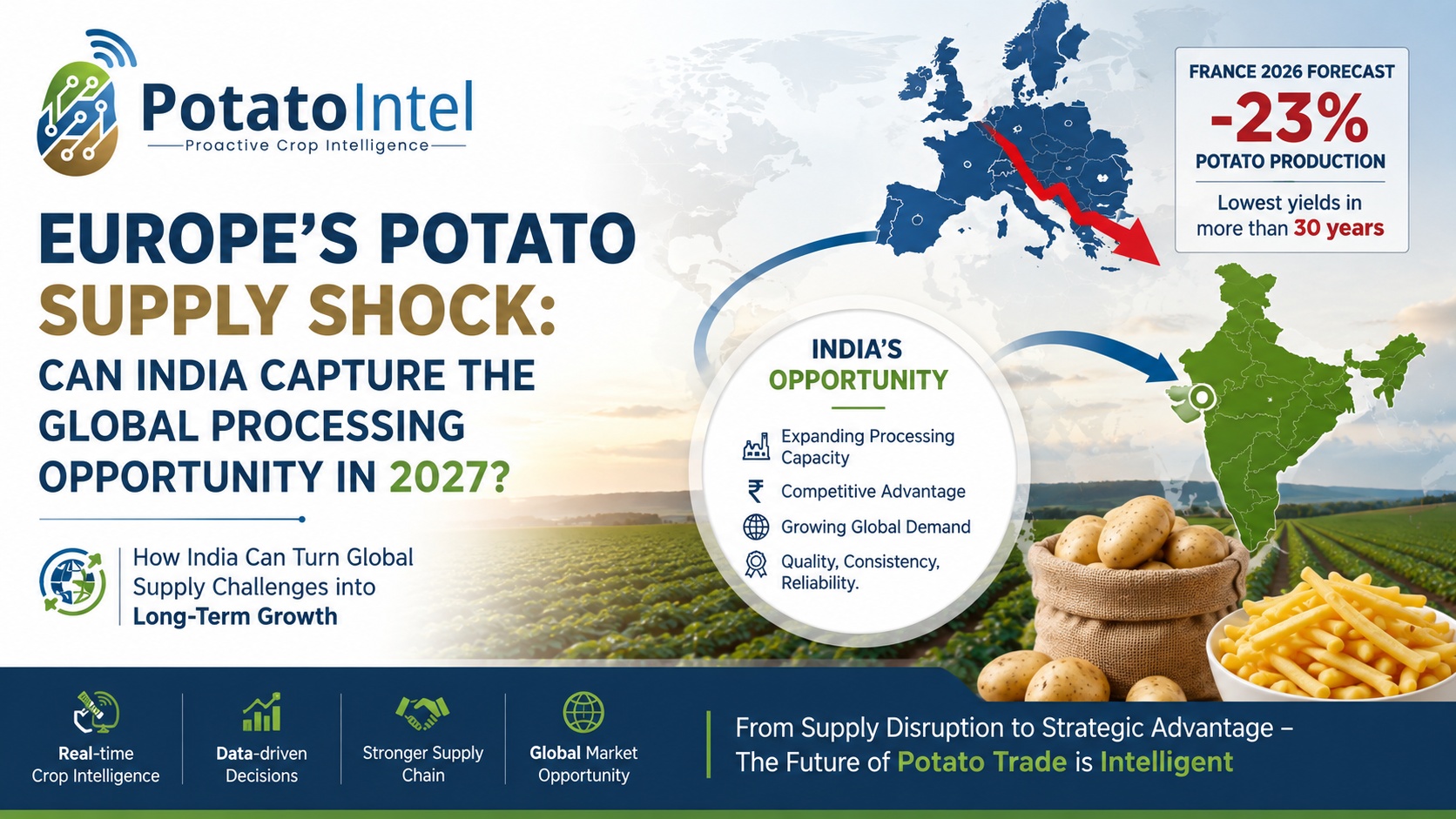
France faces its lowest potato yields in more than 30 years. For India, the real opportunity may not be the shortage itself—but what it could change in global processed-potato sourcing.
The global potato industry is entering another period of supply uncertainty.
France, one of Europe’s most important potato-producing and exporting countries, is facing a severe production setback in 2026 following repeated heatwaves, prolonged drought and irrigation constraints.
According to projections reported by Potato News Today, citing France’s national potato growers’ organisation UNPT, average French ware-potato yield could fall to approximately 37.4 tonnes per hectare in 2026.
That would be:
14% below 2025 yield levels
13% below the recent five-year average
potentially the lowest average French potato yield in more than 30 years
The problem is compounded by a 9.7% reduction in planted ware-potato area.
Together, lower acreage and reduced yields could result in French potato production falling approximately 23% compared with 2025 — close to two million tonnes of potatoes disappearing from the supply equation.
These remain forecasts rather than final harvest figures, but the magnitude deserves attention far beyond France.
For India, particularly its rapidly expanding potato-processing industry, the development could create an important strategic opportunity heading into 2027.
The European problem is about more than tonnes
The French crop has faced an extraordinary weather season.
July 2026 was reportedly France’s hottest July since national measurements began in 1900. Average temperature reached 24.9°C, 3.8°C above the 1991–2020 norm, while rainfall was 67% below average.
Potatoes are particularly sensitive to the combination of excessive temperature and moisture stress during tuber initiation and bulking.
Consequently, the French industry is not dealing only with lower gross yield.
Field observations have raised concerns about:
smaller tubers • variable dry matter • interrupted tuber development • secondary growth • misshapen or cracked tubers • glassiness • inconsistent maturity • processing performance • storage risk
This distinction is extremely important for the processing industry.
A tonne of potatoes harvested is not necessarily a tonne of processable potatoes.
French fries and other processed products require raw material to fall within relatively narrow specifications for tuber size and shape, dry matter, reducing sugars, physiological condition and fry performance.
Therefore, a decline in marketable processing-grade production can potentially become more significant than the decline indicated by gross production statistics alone.
Why France matters to the global potato trade
France is not an isolated potato producer.
It forms part of the powerful North-Western European potato production and processing ecosystem alongside Belgium, the Netherlands and Germany.
According to the same industry reporting, planted potato area across these four major North-Western European producing countries was estimated to have declined approximately 11% in 2026.
That deserves close attention.
Europe has historically been the centre of the international frozen French fry trade. Any significant disruption to European raw-potato availability can therefore influence processor utilisation, raw-material procurement, production costs, export competitiveness and eventually international sourcing decisions.
And this is where the story becomes particularly relevant for India.
India Is No Longer Just a Potential Competitor
For years, India has been described as having potential in processed-potato exports.
That description is becoming outdated.
India is already emerging as a serious exporter.
Recent industry analysis reported Indian frozen French fry exports rising 44% in the year ending October to approximately 234,000 tonnes, with India exporting frozen fries to around 65 countries.
A decade earlier, exports were reportedly below 5,000 tonnes annually.
The transformation has therefore already begun.
APEDA market intelligence provides another important signal: Indian frozen-fry exports increased approximately 31% year-on-year during the first five months of 2025, while Indian export prices were reported as competitive against several major European suppliers.
India has also developed particularly strong momentum in Gulf markets.
That means the European production problems of 2026 are occurring at almost exactly the moment when India has begun establishing itself as a credible alternative processed-potato origin.
2027 Could Become a Market-Capture Window
India should not interpret the French crop problem as merely a one-season opportunity to sell potatoes at higher prices.
The larger opportunity is market penetration.
Food-service companies, QSR chains, distributors and importers value consistency. Once buyers diversify their sourcing because an established origin becomes expensive, constrained or unreliable, some of those new supplier relationships can survive even after the original shortage disappears.
That creates a strategic possibility:
European supply disruption → buyers diversify sourcing → Indian processors gain trial orders → quality and delivery are proven → repeat business develops → India retains part of the market after European production recovers.
That is considerably more valuable than a temporary export-price spike.
Where India Has an Advantage
India’s first advantage is its expanding processing ecosystem.
Processing-oriented potato production has grown substantially, particularly around Gujarat and other organised production clusters. Contract farming, processing varieties, modern cold chains and dedicated French fry manufacturing capacity have all expanded.
Its second advantage is cost competitiveness.
Recent APEDA intelligence indicates that Indian frozen fries have been competitively priced against European origins in important export markets.
Its third advantage is geography.
India is strategically positioned for markets across the Gulf, Middle East, South Asia and parts of Southeast Asia—regions where food-service and frozen-food consumption continue to expand.
Markets such as Saudi Arabia and the UAE are particularly significant because APEDA has already identified a shift toward Indian frozen fries as European and American suppliers face cost and supply challenges.
India therefore does not need to conquer Europe to benefit from Europe’s potato problems.
It can compete for Europe’s traditional export markets.
That distinction may prove crucial.
But Two Million Missing French Tonnes Do Not Equal Two Million Tonnes of Indian Opportunity
The numbers need to be interpreted carefully.
The projected French production decline includes fresh and processing potatoes, while India’s strongest immediate international opportunity lies in value-added processed products, particularly frozen French fries.
There are also other competitors.
China has rapidly expanded processed-potato exports. Egypt has strengthened its position in Middle Eastern markets. Pakistan remains an important regional potato supplier. Belgium, the Netherlands, Germany, Canada and the United States retain enormous processing capacity and established customer relationships.
India therefore cannot assume that European disruption will automatically translate into Indian market share.
The opportunity has to be earned through processing quality, consistency and reliability.
The Bigger Challenge Is Now in the Indian Field
This is where India’s next potato revolution needs to occur.
Export expansion cannot sustainably depend simply on increasing acreage.
Processors need potatoes with predictable:
tuber size • length • shape • specific gravity • dry matter • reducing sugars • fry colour • defect levels • residue compliance • storability • traceability
A processing plant cannot manufacture globally competitive French fries from inconsistent raw material indefinitely.
India therefore needs to move from:
“producing more potatoes”
to
“producing more potatoes that consistently meet a predetermined processing specification.”
That requires a different production architecture.
Contract farming needs to become more data-driven. Variety selection needs to match processing end-use. Seed quality and physiological age need tighter control. Fertigation and irrigation should be aligned with tuber initiation and bulking rather than calendar-based fertilizer application.
Crop maturity, haulm management, harvest timing and storage decisions must increasingly be made with final processing quality in mind.
And importantly, field-level traceability needs to improve.
Gujarat Could Play a Strategic Role
Gujarat is particularly well positioned in this transition.
The state has developed a sophisticated processing-potato ecosystem combining experienced growers, contract farming, suitable winter production conditions, irrigation infrastructure and proximity to major potato processors.
The next competitive advantage, however, will not come solely from acreage.
It will come from precision and predictability.
Imagine thousands of processing-potato fields being monitored for crop stage, weather risk, irrigation, nutrition, crop health, expected yield and processing-quality development.
Processors could identify potential supply or quality problems weeks before harvest rather than discovering them when potatoes reach the factory gate.
Farmers could receive field-specific interventions rather than generic schedules.
And procurement teams could progressively build visibility over expected tonnes and quality across their production clusters.
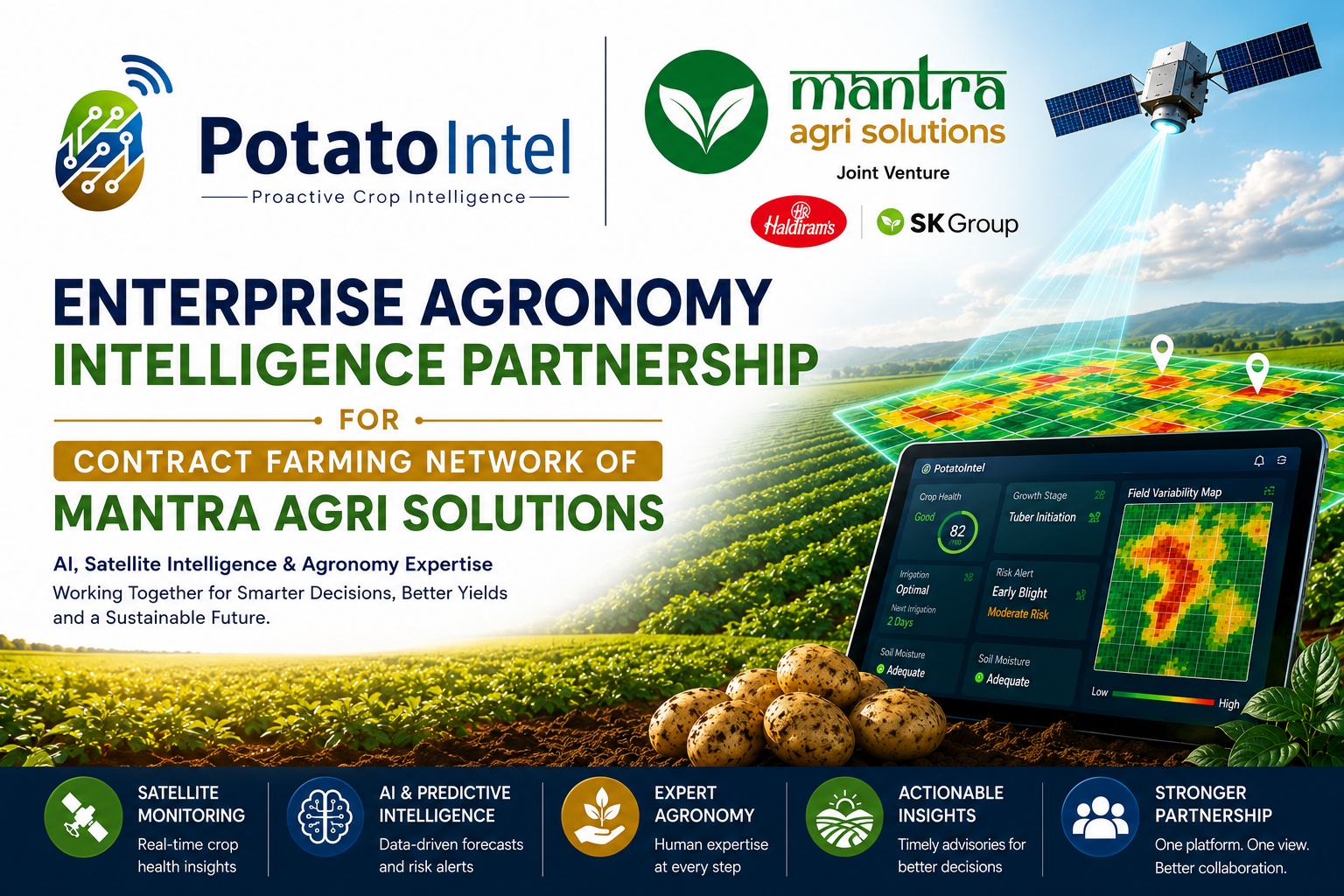
This is precisely where digital agronomy and potato-specific crop intelligence can become part of India’s export infrastructure.
From Contract Farming to Intelligent Contract Farming
India’s processing-potato sector has already demonstrated that organised contract production can create large volumes of suitable raw material.
The next phase should be intelligence-led contract farming.
Satellite monitoring, weather intelligence, soil analysis, crop-stage tracking, structured scouting, irrigation intelligence, field histories, processing-quality monitoring and predictive analytics can progressively connect what happens in the field with what processors ultimately receive at the factory.
For global customers, the selling proposition then changes.
India is no longer competing only on price.
It can compete on:
quality + cost + traceability + predictability + supply resilience.
That combination is considerably harder for competitors to displace.
The Lesson From France Is Also a Warning for India
There is another side to this story.
The same climatic forces hurting European potato production can affect India.
Heat stress, water scarcity, shortened crop duration and extreme weather are increasingly important risks for potato-producing regions worldwide.
It is a preview of the production volatility the global potato industry may increasingly face.
The countries that win the next decade may not necessarily be those with the largest planted area.
They may be those that can produce consistent processing quality despite increasing climatic variability.
That makes better irrigation management, soil health, stress monitoring, climate-resilient agronomy, improved varieties, forecasting and precision crop management commercial necessities—not merely sustainability initiatives.
India Has a Window. It Should Use It Strategically.
France’s final 2026 harvest is still underway, and the projected 23% production decline should be treated as a forecast rather than a completed statistic.
But the broader signal is difficult to ignore.
Europe’s potato industry is facing increasing production volatility at the same time that India is building processing capacity, expanding processing-grade potato cultivation and rapidly increasing frozen French fry exports.
That combination could create one of the most interesting shifts in the global potato industry in years.
India’s objective for 2027 should therefore not simply be:
“How many more tonnes can we export?”
It should be:
“How much permanent global market share can India capture while international buyers are reconsidering where their potatoes come from?”
Because supply shortages eventually recover.
Market relationships built during those shortages can last much longer.
For Indian growers, processors, exporters and potato-technology companies, the opportunity is clear:
Produce to specification.
Predict before problems occur.
Build traceability.
Deliver consistently.
And convert a temporary global supply disruption into a permanent Indian market opportunity.
Potato Intel Perspective
At Potato Intel, we believe the future of processing-potato competitiveness will increasingly depend on connecting field-level agronomy with processing-quality intelligence.
The global potato market is becoming more climate-sensitive, quality-driven and data-dependent. India’s advantage will therefore not be determined by production volume alone, but by its ability to deliver predictable yield, processing quality and traceable supply at scale.
That is the transition from potato production to potato intelligence.
Sources & Further Reading
Primary market development: Potato News Today, “French potato production could fall 23% as drought and heat cut yields: Lowest yields in more than 30 years,” 24 August 2026.
Supporting information: UNPT, ARVALIS and Météo-France information referenced in the Potato News Today report; APEDA Market Intelligence Cell potato reports; Government of India trade statistics; and international potato-market analysis.